Tell us about the job
Takes about a minute. No obligation.
A heat pump asked to cover cold Oregon winters runs its refrigerant circuit hard, cycling defrost controls and compressor stages across months when outdoor temperatures push the system toward the bottom of its capacity curve. Homes in Deschutes County, OR run heat about ten months a year, from September through June. By the time a contractor opens a unit for repair, the compressor and reversing valve have logged a workload that shows up in worn contacts, weakened refrigerant charge, and defrost boards that have cycled past their design expectations. Those are the components a contractor prices first here, before looking at anything downstream.
Stock adapted to carry a heat pump has usually had its ductwork and wiring reworked already, so what stops a system here tends to be inside the unit itself. Half the homes in Deschutes County, Oregon were built in 1998 or earlier (2020-2024 ACS 5-year). A house that old has had time to accumulate those adaptations, and a contractor opening a heat pump in this county finds refrigerant circuits, contactors, and reversing valves that have run through many seasons of both heating and cooling demand. The parts question matters here: whether a system of that vintage still has a supply chain behind it shapes what a repair actually costs and whether a repair is the right path.
The Parts of a Heat Pump a Contractor Checks First
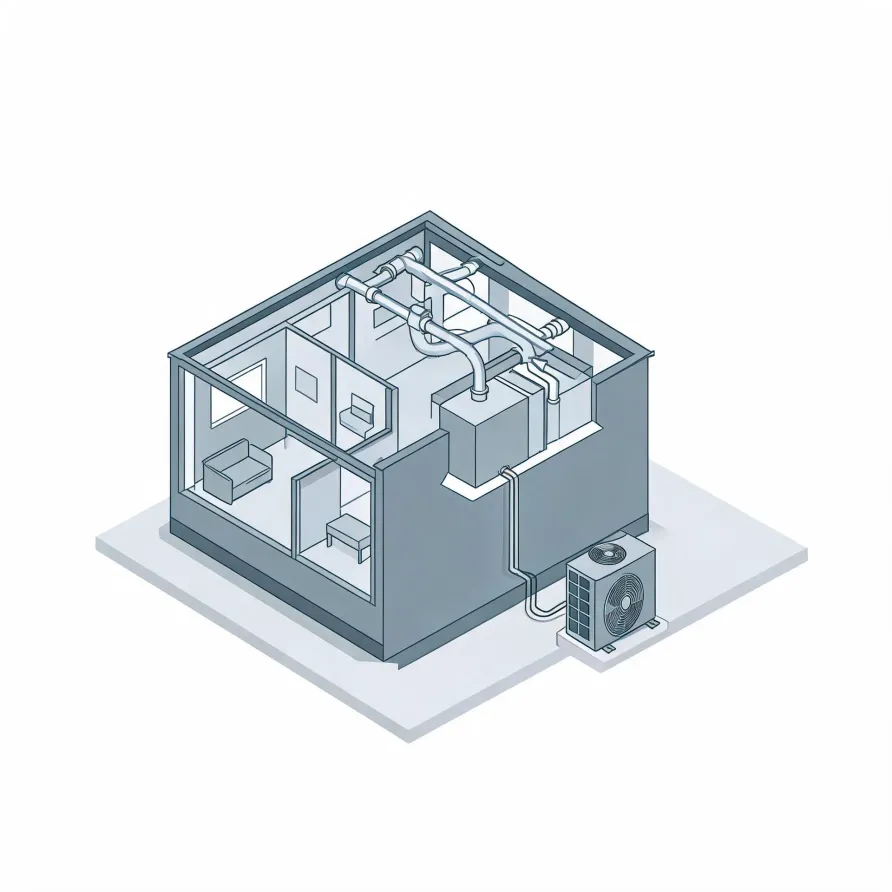
The outdoor unit sits outside the house and holds the compressor, which is the piece a contractor reaches for first when a heat pump stops moving heat the way it should. The coil wrapped around that cabinet and the fan above it work together with the compressor, so a fault in any one of them shows up as the same symptom.
Inside the house, the air handler holds the indoor coil and the blower fan that pushes conditioned air through the home. Running between the two units, the refrigerant lines and the reversing valve are what allow the system to shift between heating and cooling, and both are common places for a repair call to end.
The drawing shows a typical layout, and a licensed contractor determines what applies to this particular house.
Get matched in Deschutes CountyDeschutes County, by the record
135 severe weather events were recorded in Deschutes County, Oregon between 2015 and 2024.
NOAA National Centers for Environmental Information, Storm Events Database, bulk CSV export, events 2015-01-01 through 2024-12-31.Half the homes in Deschutes County, Oregon were built in 1998 or earlier (2020-2024 ACS 5-year).
U.S. Census Bureau, 2020-2024 American Community Survey 5-Year EstimatesDeschutes County, Oregon holds 99,297 housing units (2020-2024 ACS 5-year).
U.S. Census Bureau, 2020-2024 American Community Survey 5-Year EstimatesOwners occupy 70.0% of the occupied homes in Deschutes County, Oregon (2020-2024 ACS 5-year).
U.S. Census Bureau, 2020-2024 American Community Survey 5-Year EstimatesRules & Standards Governing Heat Pump Repair in Deschutes County, Oregon2 sourced rules and standards
Licensing and Legal Requirements in Deschutes County, Oregon
Oregon’s contractor licence does not reach casual, minor or inconsequential work on one structure where the person’s contracts total less than $1,000 — and the exemption is unavailable to anyone who advertises or signs themselves as a contractor, at any price.
Oregon requires a current Construction Contractors Board licence, with the right endorsement, to undertake, offer to undertake or bid construction work.
Severe Weather Events in Deschutes County
Extreme weather puts heat pumps under sustained stress, and how hard a system works over time shapes what repairs it eventually needs. That load is local, tied to what the climate here actually does.
135 severe weather events, 2015–2024. Source: NOAA National Centers for Environmental Information, Storm Events Database.