

What emergency heat means on an Oregon heat pump

Step 1 of 3: Equipment

Emergency heat is a setting on your thermostat, usually labeled "EM HEAT" or "AUX," that shuts off the outdoor unit and heats your house with backup electric resistance coils instead. Your heat pump normally pulls warmth from the outside air, even when it's cold out. In Oregon winters, the outdoor unit can ice over, and it needs to run a defrost cycle to clear that ice. If the outdoor unit stops running, freezes up and won't defrost, or the fan or compressor fails, switching to emergency heat keeps your house warm while you get it looked at. It uses more electricity than the heat pump does on its own, so running it for more than a short stretch is a sign something outside needs attention, not a setting to leave on through the winter.

A white outdoor heat pump unit on rubber feet atop a concrete pad beside a light stucco wall, with gray siding and a small shrub at the left edge.

Why the switch gets used at all

A heat pump moves heat from the outside air into your house. Below a certain outdoor temperature, usually somewhere in the teens or 20s, there isn't enough heat left in that air for the unit to keep up, so the backup coils take over automatically. The EM HEAT setting does the same thing by hand. You'd use it if the outdoor unit ices up and won't defrost, or stops running altogether, so your house still gets warm while that gets looked at.

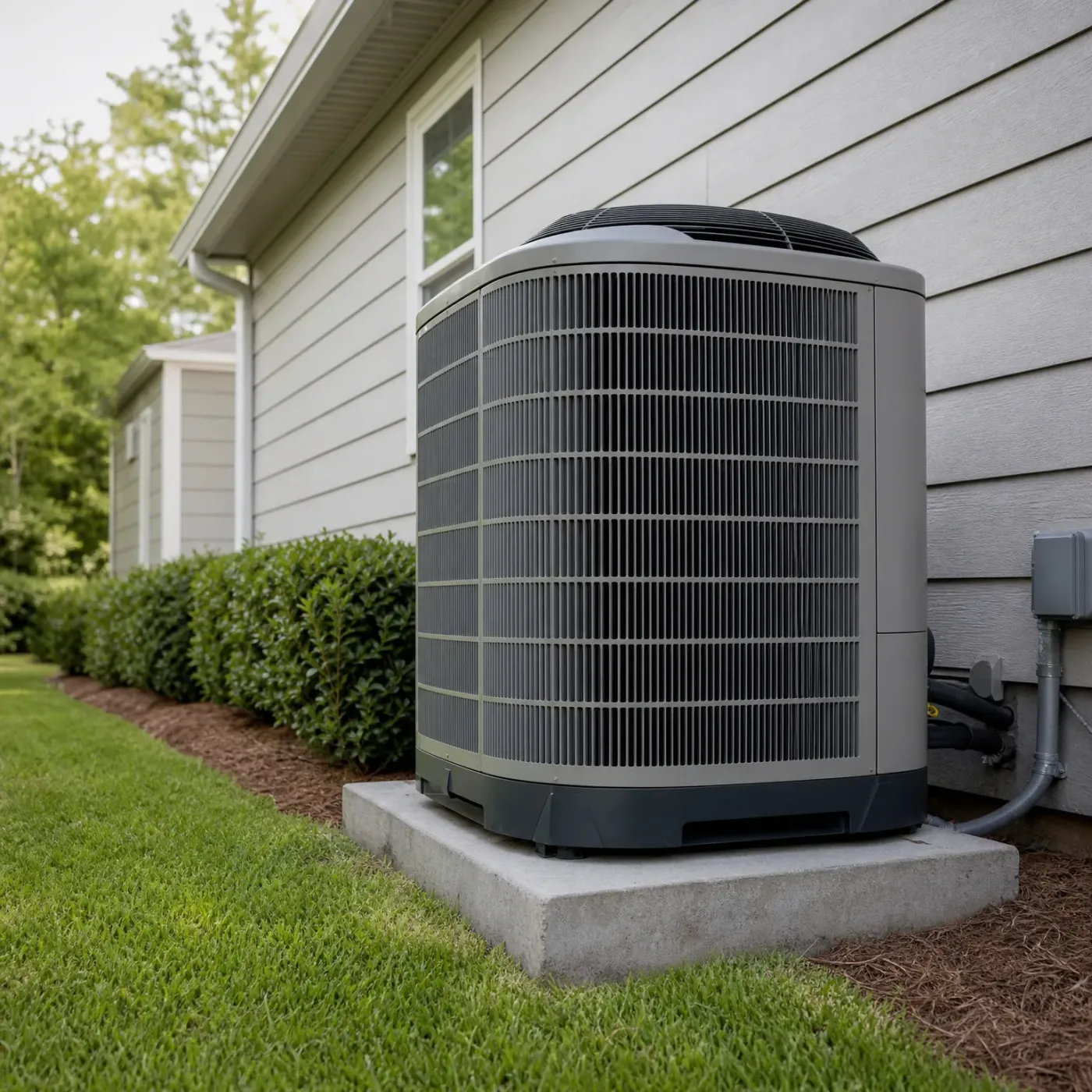
A gray outdoor heat pump unit with a large circular fan grille sits on a concrete pad beside a house with horizontal siding, surrounded by gravel and grass, with a conduit and junction box on the wall.

What it costs you to run it

Electric resistance coils make heat directly from electricity, the same way a toaster does. A heat pump running normally moves heat instead of generating it, so it uses less power to deliver the same warmth. Leaving a thermostat on EM HEAT for more than a day or two, when the outdoor unit could otherwise run, means paying more to heat the same rooms. It's meant for a short stretch while something gets fixed, not a setting to leave on through a cold snap.

Power costs 15.46 cents per kilowatt-hour statewide

At 15.46 cents per kilowatt-hour, running on emergency heat costs you more than your heat pump normally does, since those backup coils make heat with electric resistance instead of just moving it. Leave it on EM HEAT longer than a repair takes and you'll see it on your bill.

EIA-861 2025 statewide residential average

When the switch makes sense

If your outdoor unit is frosted over, making noise it shouldn't, or just not running at all, flipping to EM HEAT keeps the house warm while you sort it out. It takes the outdoor unit out of the picture entirely, so whatever's wrong with it, a bad fan motor, a stuck valve, a refrigerant leak, won't leave you without heat overnight. For someone who'd rather deal with a problem early than let it sit, this is the right reason to use it. You're not fixing anything by switching it on, just buying yourself time until a contractor can look at the unit.


When it's doing more harm

If the thermostat's been sitting on EM HEAT for weeks and nobody remembers why, that's a different situation. The outdoor unit might be working fine, just switched out of the loop by mistake, or left there after a repair that already happened. Those backup coils aren't meant to carry the whole house long term, and your electric bill will show it. A local contractor who works on heat pumps all season can usually tell within a few minutes whether the outdoor unit is the problem or whether it just needs to be switched back on.

A woman in a cream cowl-neck sweater sits by a window with snow outside, in a dimly lit living room with a sofa, lit lamp, mirror, candles and a fireplace.
A woman in a gray turtleneck sweater sits beside a large window looking out at snow-covered evergreen trees, in a dimly lit living room with a lit fireplace, lamps, couch and houseplant.
A woman in a cream turtleneck sweater stands beside a large window with snow-covered ground and bare trees outside, in a dimly lit living room with lamps, a sofa and framed art.
A woman in a grey cowl-neck sweater stands indoors near a window, looking out at falling snow, with a lamp, framed picture and couch in the warmly lit room behind her.

Your thermostat won't tell you why it switched to EM HEAT on its own, only that it did. That's your outdoor unit asking for a repair, not a setting to leave alone.

Left on EM HEAT through a cold stretch, those backup coils will keep the house warm, and at 15.46 cents a kilowatt-hour you'll feel it on the next bill.

A bearded man in a blue and brown plaid flannel shirt stands indoors looking out a window at snow-covered trees, with a ceramic mug on the windowsill.
A man in a blue T-shirt sits on a light gray sofa, laughing while looking at an open laptop in the foreground, with a framed picture, lamp and potted plant behind him.
An outdoor condenser unit on a concrete pad beside a light-colored lap-sided house, with a trimmed hedge, mulch bed and mowed lawn nearby and an electrical box and conduit on the wall.

Matched to your heat pump job

Only one pro gets your request, so you hear from one company.

Describe your heat pump job, and a local pro who handles it gets in touch.

Get a local pro

You're not committing to anything by asking.

A dark gray outdoor condenser unit on a concrete pad beside a house with beige horizontal siding, with a gray electrical disconnect box and conduit on the wall, mulch beds, a hosta plant, a shrub, and mowed lawn in front.
Running fine, the outdoor unit sits quiet and clean, pulling heat from the air with nothing to fix.
A weathered outdoor condenser unit on a concrete pad beside a house with light horizontal siding, surrounded by bare dirt and a shrub.
Caked in grime like this, an outdoor unit works harder to move heat and is more likely to trip into EM HEAT.

Why is my heat pump stuck on EM HEAT?

You'll notice it on the thermostat display before anything else, EM HEAT or AUX lit up when you didn't put it there. The outdoor unit has gone quiet, maybe iced over or making a noise you haven't heard before. The house still feels warm, because the backup coils are covering for it, but your electric bill that month will run higher than usual since those coils cost more to run than the heat pump does on its own. Leave it in that state through a stretch of cold weather in Oregon and the extra cost keeps adding up while the actual problem with the outdoor unit sits there unfixed.

  1. The thermostat calls for heat at the set temperature.

  2. Normally the outdoor unit pulls heat from outside air.

  3. A sensor or fault signal tells the system to stop.

  4. EM HEAT locks the outdoor unit off completely.

Call now or ride it out

Call now

  • If your outdoor unit has already gone quiet or thrown a fault, EM HEAT holds the house at temperature while a contractor gets out to look at it.
  • A licensed contractor local to you works on heat pumps all year and knows what usually causes a unit to lock out like this.
  • You get matched with one contractor, not a handful calling you back, so you can describe what the thermostat is showing and move straight to scheduling.
  • The backup coils will keep up in an Oregon winter, but they're the more expensive way to heat the house, so the shorter this stretch is, the better.
  • Someone who deals with small problems early catches this before a stuck unit turns into a bigger repair or a skipped winter of real heat pump savings.

Wait and watch

  • If the thermostat switched on its own, that's the system telling you something failed outside, not a setting that fixes itself by waiting.
  • Frost, a dead sensor or a failed component doesn't clear on its own, so the outdoor unit stays locked out until someone repairs it.
  • Every day on EM HEAT runs up the electric bill further, since those coils heat by resistance instead of moving heat the way the outdoor unit does.
  • Putting it off doesn't lower the eventual bill, it just adds the extra EM HEAT costs on top of whatever the repair runs.
An outdoor air conditioner condenser unit on a gray composite pad beside a house with horizontal lap siding, with refrigerant lines and a conduit running to a wall-mounted disconnect box, and a shrub at left.
Before you get your heat pump repair
A gray outdoor condenser unit on a raised pad beside a house with horizontal lap siding, with refrigerant lines, conduit and an electrical disconnect box on the wall, and shrubs on a mulch bed to the left.
After you get your heat pump repair

What EM HEAT Is Telling You

  • EM HEAT switches your heat pump off and runs the backup coils by themselves, at a higher cost than normal operation.
  • A thermostat that switches to EM HEAT on its own is reporting a problem with the outdoor unit, not offering a setting to use.
  • A frosted coil, a strange noise, or a unit that won't run are all reasons to flip the switch while you wait on a repair.
  • Oregon winters rarely push outdoor temperatures low enough to need backup heat for more than short stretches.
  • A contractor local to you who works on heat pumps through the winter knows what usually causes a unit to drop into EM HEAT.
  • Getting matched with one local contractor means one call back, not a string of them from companies that don't know your system.

EM HEAT is a report, not a setting worth leaving on. It means your outdoor unit stopped moving heat from the air and the backup coils took over on their own, running up your bill until someone looks at what stopped it. Maybe it's frost that shouldn't be there, a noise you haven't heard before, or the unit just sitting silent. Whatever it is, EM HEAT buys you time to get it looked at, not a reason to stop looking.

Oregon winters don't usually ask much of backup heat. Outdoor temperatures here rarely drop low enough, or stay there long enough, to need those electric coils for more than a short stretch. If your thermostat is stuck on EM HEAT through a normal cold night, something in the outdoor unit needs attention, not patience.

Getting that attention right matters as much as getting it fast. A contractor who works on heat pumps all winter has seen this before, the frozen coils, the failed sensor, the fault that trips the switch without any warning, and knows where to look first. When you ask to be matched, you're handed to one contractor, local to your area, not a list of names competing for the callback. One licensed contractor who already knows this equipment, reaching out once, is worth more than a handful of strangers guessing at the same problem.

Interior room corner with sunlight from a window, showing peeling paint and damaged plaster on the wall above a white baseboard, a wooden cabinet with a pale bowl on top, hardwood floor and a patterned rug.
Interior corner of a room with tan walls, white profiled baseboard and window trim, a wood-plank floor in sunlight, and green foliage visible through the window.
An empty room corner with cream walls, white baseboard, two windows with deep sills showing green foliage outside, and a wood plank floor lit by sunlight.
Empty room corner with beige walls, white beadboard wainscoting, chair rail and baseboard, a window with green foliage outside, and sunlight casting leaf shadows on the wall above a wood floor.
Sunlit room corner with a multi-pane window, beige walls, white baseboard, wood floor with a woven rug, and a dark wooden cabinet holding a ceramic table lamp below a framed picture.

A heat pump pro near you

Your request stays with one local pro.

Match me with a pro

It costs nothing to send, and you don't have to hire anyone.