
Sized right
A heat pump that matches your house runs long, steady cycles and keeps rooms at an even temperature. It holds up through winter here without strain, and the outdoor unit stays clean because it isn't working harder than it needs to.
One request ends the search for a heat pump installer.
There's no single size that fits every house, and anyone who gives you a number without doing a load calculation is guessing. The right size comes from your square footage, your insulation, your windows, and how the house holds heat through an Oregon winter. Go too big and the unit short cycles, turning on and off instead of running a steady, even stretch, which wears it out faster and leaves rooms uneven. Go too small and it struggles on the coldest nights, leaning hard on backup electric heat to make up the difference, and since most homes here heat with electricity, that shows up on your bill. A manual J load calculation is the only way to get this right. It weighs your home's actual heat loss and heat gain against the equipment, not a rule of thumb based on square footage alone. That calculation is also the starting point for a proper installation.

A heat pump that matches your house runs long, steady cycles and keeps rooms at an even temperature. It holds up through winter here without strain, and the outdoor unit stays clean because it isn't working harder than it needs to.

An oversized or undersized unit short-cycles or runs nonstop, and either way it wears out faster. A dirty, darkened grille like this often means the unit has been straining to keep up, pulling in more dust and debris as it runs.






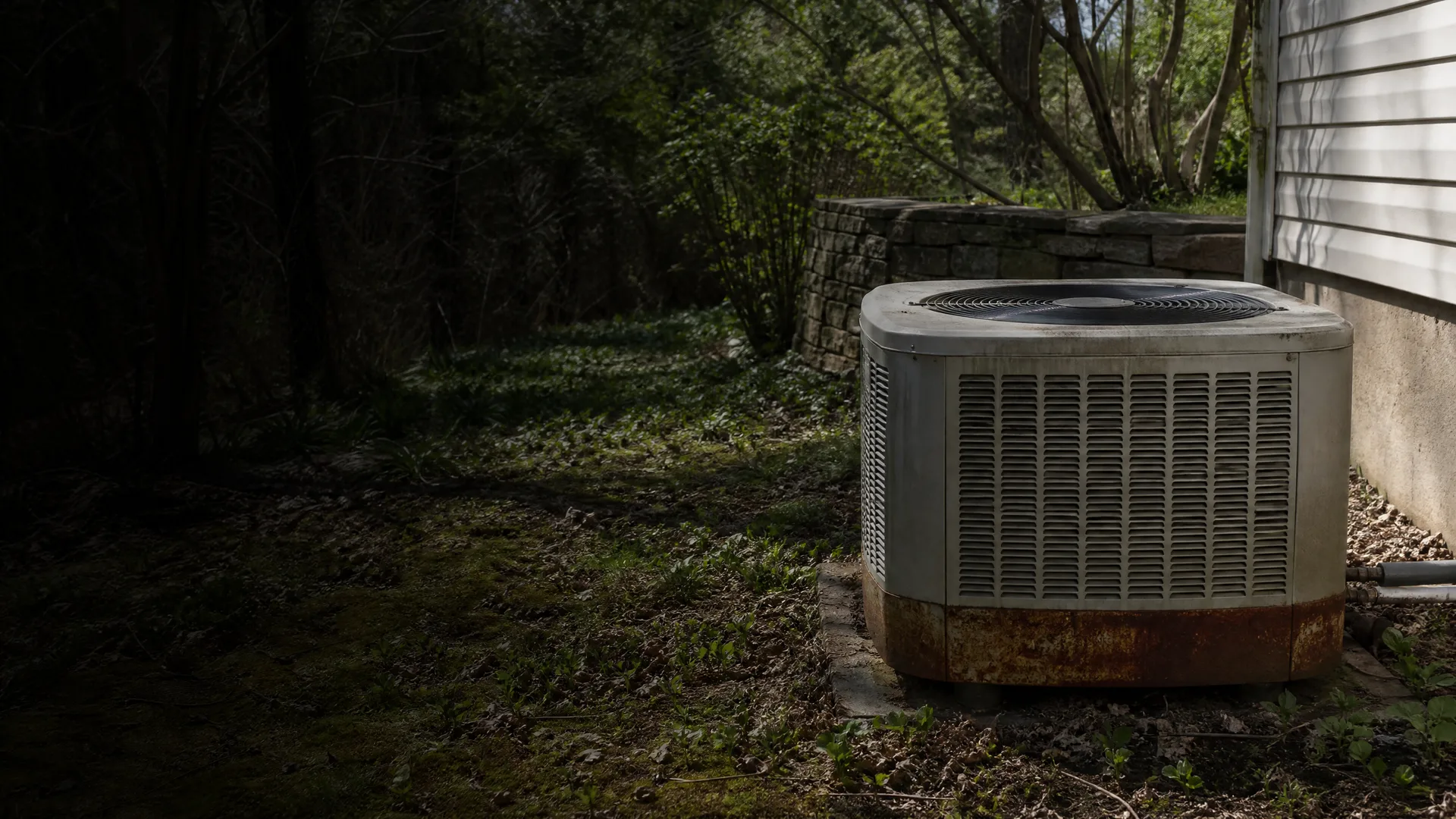
You're out checking the yard on a spring afternoon when you notice it again, the rust creeping along the base of the outdoor unit. It's been there a season or two, you figure, but today it catches your eye differently. You crouch down and look closer. The casing is pitted where water's been sitting against the metal, and the ground around the pad stays damp longer than it should. You think back to last winter, how the system seemed to run almost constantly on the colder nights. That kind of strain adds up. You straighten up, decide you've put this off long enough, and head back inside to finally do something about it.
One installer gets your project, so there's no bidding war over it.
No fee to send it, and nothing to sign.
A load calculation accounts for your square footage, but also your windows, your insulation, and your ceiling height. Two houses the same size in the same Oregon town can need different sized units.
That's why the contractor comes to measure your house instead of asking for its square footage over the phone. A heat pump picked from a square footage chart alone is a guess, not a calculation.
At 15.46 cents per kilowatt-hour, a heat pump sized too big for your house costs you more every month it runs, since it's cycling on and off instead of settling into a steady draw. Getting the size right the first time keeps that rate working for you, not against you.
EIA-861 2025 statewide residential average
The contractor measures every room, window, and wall in your house.
Those measurements and your insulation feed a Manual J load calculation.
The calculation sets the exact heating and cooling load in BTUs.
The contractor matches that load to a heat pump sized to carry it.
You've seen the steps above, the measuring, the Manual J, the matching of BTUs to equipment. But you still want to know what actually separates a good size recommendation from a guess. You've probably heard a contractor rattle off a number based on square footage alone, and you want to know if that's the same thing or not.
Square footage alone tells a contractor almost nothing. A Manual J calculation also factors in how many windows face which direction, how much insulation is in the attic and walls, and how tall the ceilings run. Two houses with the same floor plan in the same Oregon neighborhood can land on different sized units once those details are counted. A contractor who skips this and quotes a size over the phone, before ever walking your house, is working off a guess dressed up as an estimate. The one who measures first and runs the numbers is giving you a size that matches your house, not just its square footage.

Summer air here holds a dew point of 52°F, which is dry enough that your skin barely notices the humidity. That changes what sizing is really about where you live. A heat pump here isn't fighting to wring moisture out of thick air, so an oversized unit doesn't even get that partial excuse. It just cycles on, blasts cold air, and shuts off, leaving rooms swinging in temperature instead of settling even. The right size matters here for comfort and even heat, not for drying out a muggy house. Source: NOAA climate normals.
NASA POWER T2MDEW county cells weighted by homes


A load calculation tells you what your house needs. No two houses in the same Oregon town need the same size, even if the square footage matches, because the windows, the insulation, and the way the place holds heat through winter all factor in. That's the number a contractor works from, not a guess off a chart.
The contractor you hear from is local, and installs and services heat pumps through Oregon winters every year. That matters more than it sounds like it should. Someone who works on this equipment in this climate season after season has already seen what tends to go wrong when a unit is sized off. They know what a mild Oregon summer does to an oversized system, and what a hard winter does to one that's too small. That's not something a sizing chart knows.
You'll hear from one contractor, not a handful competing for the job. One person who's already looked at your numbers, not a stack of quotes to sort through while your old unit keeps running the way it's running now.
Get the size right and the rest follows. Long, steady cycles instead of short ones that strain the compressor. An outdoor unit that isn't working harder than the house asks it to. A bill that reflects the house you actually have, not a number pulled from a guess. That's what the load calculation is for, and it's why the measuring comes before the quote, not after.

Sending the form costs nothing.
A heat pump sized right doesn't ask you to think about it again. Send the request and let a local contractor work out the number for your house, so you can stop wondering whether the one you have, or the one you're about to get, is actually right.