Send the request today and stop worrying about who to call.
Your heat pump won't start and in most Oregon homes that means no heat at all, since electricity is what runs the furnace too. That makes this worth sorting out fast, not leaving for a day or two.
A heat pump that won't turn on can come down to a few different things. A tripped breaker or blown fuse. A bad thermostat or a wiring problem between the thermostat and the unit. A failed capacitor, contactor or control board. The outdoor unit frozen solid. Each of these needs someone to actually look at the system to tell which one it is.
That's the part that takes the time, normally. Calling around to find a contractor who works on heat pumps, waiting to hear back, explaining the same problem over and over to whoever picks up, then trying to compare what each one quotes you. With no heat in the house, that back and forth is the last thing you want to be doing.
Send the form on this page and that search is done. You won't be the one tracking down who's available or sitting on hold. A contractor who knows heat pumps and works in Oregon gets the details of what's going on, and from there it's on them to follow up.
What's actually wrong with your unit still needs a technician standing in front of it. But finding that technician doesn't have to be something you spend your afternoon on. That's the piece this page takes off your plate.
A heat pump that won't turn on usually comes down to power, the thermostat, or the outdoor unit itself. Check the breaker first, heat pumps trip them more than people expect, especially during a cold snap when the system is working hard. If the breaker's fine, look at the thermostat. A dead battery or a setting knocked off "heat" will leave the system sitting there doing nothing, and it looks identical to a real failure from where you're standing. Outside, the unit can freeze up in winter weather. Some frost is normal and clears on its own, but a solid block of ice usually means the defrost cycle isn't working, and the unit will stay off until that's fixed. Less often, it's the control board or a failed capacitor, parts that need a technician to test and replace. Since this system is likely your only source of heat, it's worth having someone look at it before the house gets cold.
A heat pump doesn't make heat the way a furnace does. It pulls heat from outside air and moves it in, switching a reversing valve instead of lighting a flame. That means the outdoor unit has to be working for any of this to happen. If the compressor or fan motor out there has failed, nothing inside will turn on no matter what the thermostat says. The system also runs a defrost cycle on its own schedule to clear ice off the outdoor coil, and if that control sticks, the unit can lock itself out as a safety measure. The same goes for a frozen coil that never fully cleared. A low-voltage fuse on the control board is part of this too, since it's what signals the outdoor unit to start, and a blown fuse stops the compressor before it ever gets power. And if your system just shut off a few minutes ago, it may simply be sitting through the delay most thermostats build in to protect the compressor between cycles. That's not a failure, that's the system doing what it's supposed to do.
How a heat pump actually starts
A heat pump calls for heat the same way an AC calls for cool, by reversing a valve rather than lighting a flame.
The outdoor unit has to run even in cold weather, so a failed compressor or fan motor out there kills the whole system.
A defrost cycle runs automatically to melt ice off the outdoor coil, and a stuck defrost control can leave the unit locked out.
Low voltage from the control board tells the outdoor unit when to start, so a tripped low-voltage fuse stops it before the compressor ever gets power.
Most thermostats need a few minutes of delay between cycles to protect the compressor, so a unit that just shut off may not restart right away on purpose.
A frozen outdoor coil from a failed defrost cycle can trip a safety switch that shuts the whole system down until it's cleared.
Before you get your heat pump repairAfter you get your heat pump repair
A heat pump that won't start on a cold morning isn't something to sit with while you try to figure out which of the usual causes it is. You could keep flipping the breaker, resetting the thermostat, and waiting to see if the outdoor unit kicks on, and still not know if the problem is the defrost control, a failed motor, or something electrical. That's hours gone, and in an Oregon winter, hours without heat in a home that runs on electricity matter. Sending the request means you're not the one calling around to find out who's available, explaining the same problem three or four times, or sitting on hold comparing quotes from people you don't know yet. A contractor gets your request and takes it from there. You stay warm faster not because the repair itself speeds up, but because the part that used to be your job, finding someone who can actually do it, isn't anymore.
Running the way it should
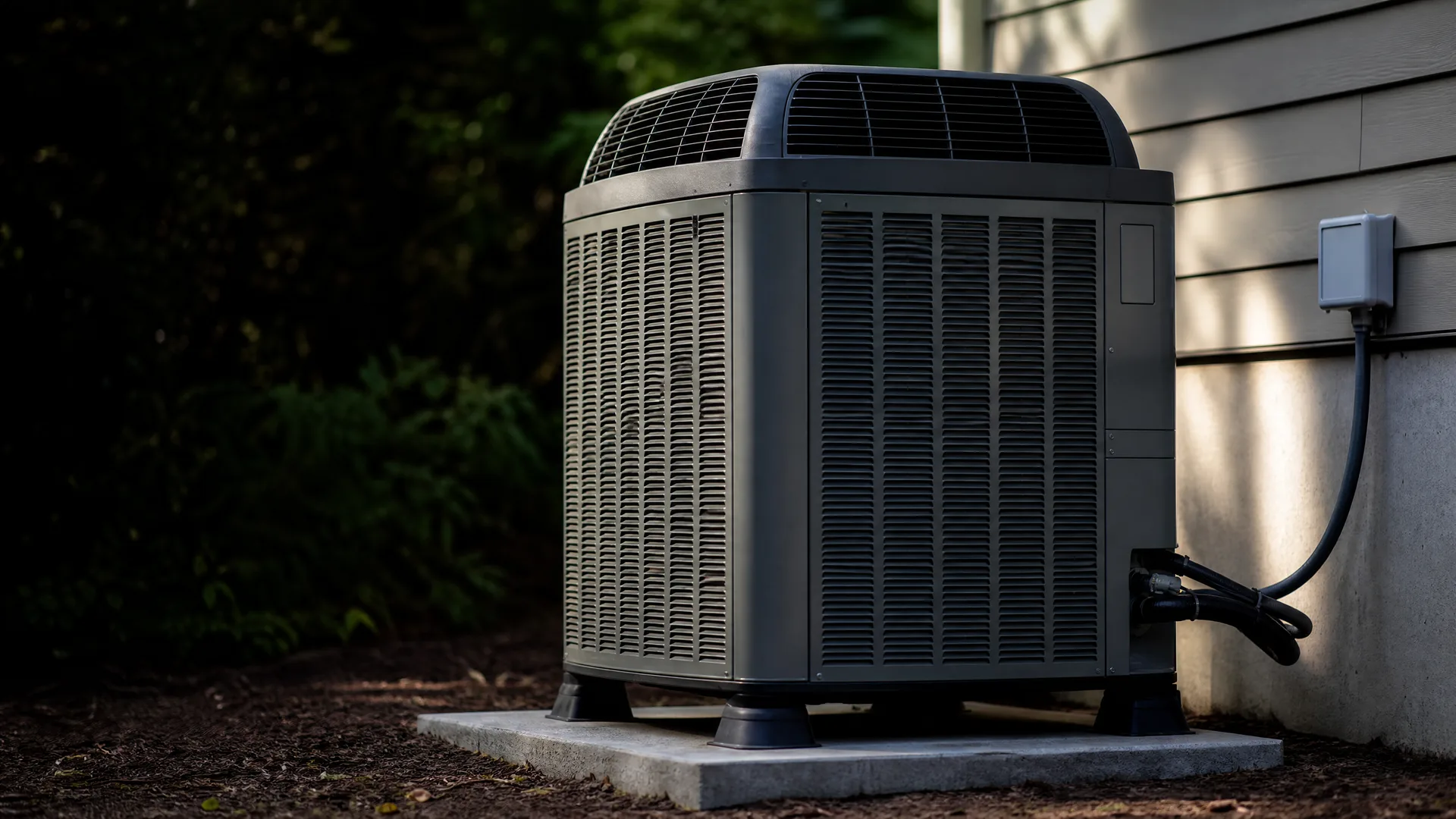
The outdoor unit sits quiet and even on its pad, the conduit carrying power up to the disconnect without a mark on it. On a normal day this is all you'd ever see of it, cycling on when the thermostat calls and doing its job out of sight.
Not drawing power
Same unit, same spot against the wall, but nothing's turning. If the fan inside isn't spinning and you can't hear the compressor, the disconnect box is the first place to check, that's often where the problem starts before it ever reaches the breaker panel.
Power costs 15.46 cents per kilowatt-hour statewide
At 15.46 cents a kilowatt-hour, running a heat pump here costs close to what the rest of the country pays, nothing extreme either way. So when it won't turn on, you're not losing money while it sits dead, just heat. That's the part worth fixing fast.
EIA-861 2025 statewide residential average
Working like it should
The unit sits clean on its pad, the lines and conduit running straight up to the disconnect box. Nothing on it looks worn or loose. It cycles on when the thermostat calls for heat and you don't think about it again until the next time.
Dirty and failing
Dust has built up across the cabinet and the conduit running to the disconnect shows its age. A unit left to weather like this is more likely to trip a breaker or stall out on a cold morning, right when you need the heat most.
Call for help or keep checking it yourself
Call a contractor now
You explain the problem once, to one person, instead of repeating it to every company you call.
Finding someone who can actually look at it stops being your job the moment the form is sent.
You skip the back and forth of comparing quotes while the house sits cold.
Whatever's wrong gets diagnosed by someone who does this daily, not guessed at by trial and error.
If it's the outdoor unit or the reversing valve, that's not something to keep testing on your own.
Keep troubleshooting yourself
You've already checked the breaker and the thermostat, so you might find it's something that simple.
You save the time it takes to search for a contractor, call around, and wait on quotes.
If it starts back up on its own, you've avoided the whole process for nothing.
You risk losing another cold morning or two if the real problem is in the outdoor unit.
Resetting the breaker again and watching the fan won't tell you why it tripped in the first place.
Oregon summers don't feel sticky, and the numbers back that up. Averaged across June, July and August, the dew point here sits around 52°F, which is dry air by most standards. That matters more for your heat pump's winter side than its summer one. Dry air outside in winter means less moisture for the outdoor coil to pull in and freeze over, so the unit isn't fighting constant defrost cycles the way it would somewhere humid. If yours won't start, you can rule out a coil buried in ice as the likely culprit and look closer at the breaker, the thermostat, or the outdoor unit's motor and controls.
NASA POWER T2MDEW county cells weighted by homes
The pad is clean, the mulch is undisturbed, and the disconnect box on the siding shows no sign anyone's had to touch it.
Dirt packed into the fins and a weathered cabinet like this often go along with a unit that's lost its fan motor or compressor.
A dead heat pump has a short list of causes
Power, the thermostat, or the outdoor unit. That's where this comes from almost every time, and a lot of it starts with something as plain as a tripped breaker. The rest takes a contractor's eyes on it, especially if the compressor or fan motor outside has quit.
You don't have to be the one who finds that contractor. Once you send the form, you're done calling around, done explaining the same problem to a third or fourth company, done trying to sort through quotes that don't tell you much on their own. Someone gets matched to the job, and from there it's theirs to figure out, not yours.